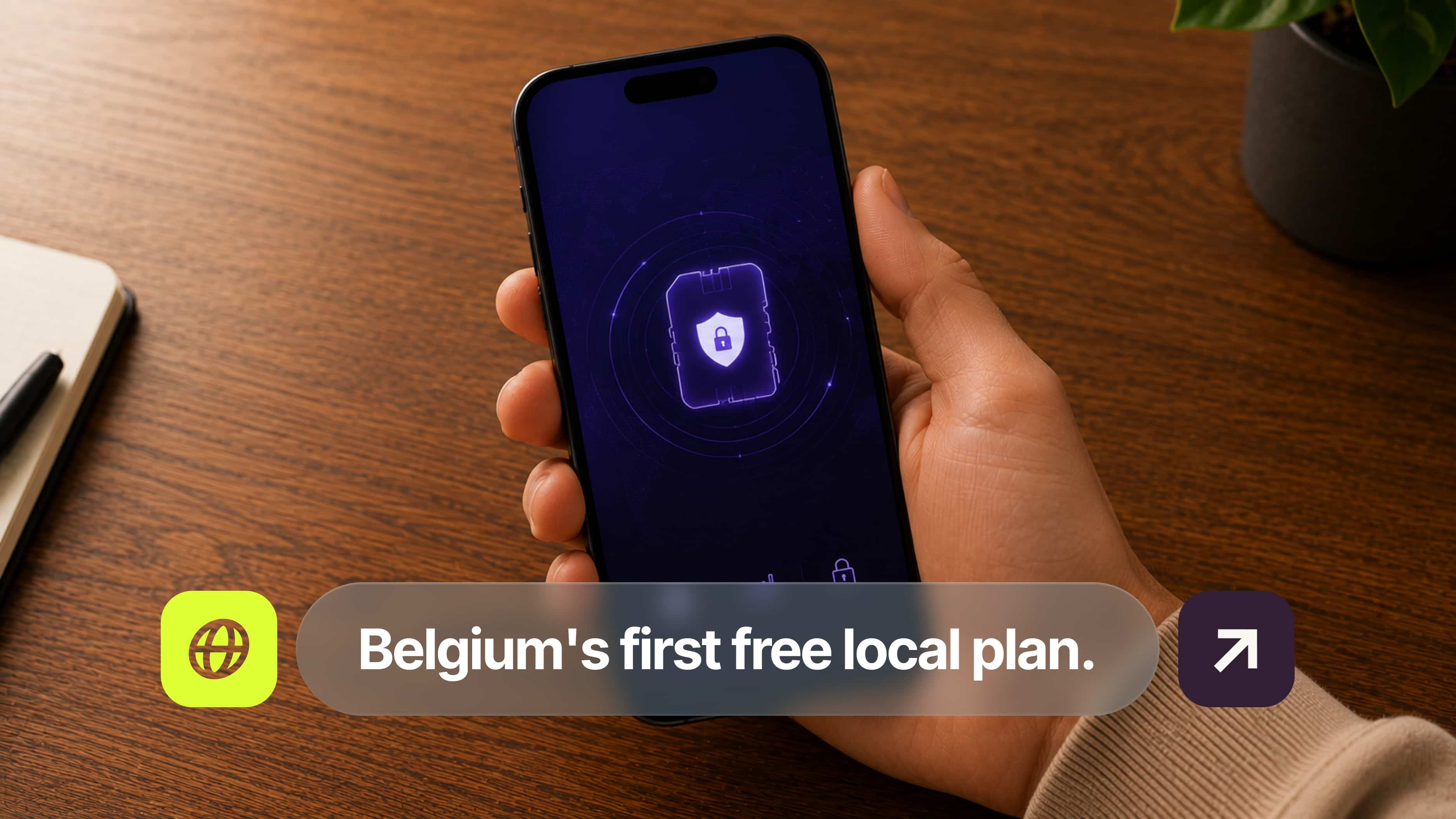
Yes, an eSIM is safe to use. It cannot be physically removed, swapped, or cloned the way a traditional SIM card can, an eSIM lives inside your device as an encrypted digital profile rather than a removable chip. The security risks that do exist with eSIMs come from the same place they always have with mobile accounts: phishing and weak account protection, not the eSIM technology itself. Understanding how eSIMs actually work makes it clear why they hold up so well, and what to check to keep your connection secure.
That single answer covers most of what people worry about, but it only holds up if you know what to actually check before and after activation. Below, we break down how eSIM security works, what real risks to watch for, how to verify the security of your eSIM, and how eSIM stacks up against a physical SIM card.
How an eSIM Actually Works
An eSIM, short for embedded SIM, is a small chip built directly into your phone, tablet, or smartwatch. Instead of inserting a physical card, your mobile provider sends your SIM profile to the device digitally, usually through a QR code or an activation link. That profile is encrypted and stored securely on the embedded chip, where it cannot be removed, copied, or physically tampered with the way a plastic SIM card can be.
This is one of the clearest advantages eSIM technology has over traditional SIM cards. There is no card to lose, no card to steal from your wallet, and no physical swap a stranger can perform without your knowledge.
Is eSIM Technology Secure by Design?
Yes. eSIM profiles are protected by encryption standards set by the GSMA, the same industry body that oversees global mobile network standards. Every profile transfer between your provider and your device is authenticated, so an unauthorized party cannot simply intercept or duplicate your SIM information mid transfer.
Devices with eSIM support can hold multiple profiles at once, switch between them without a new physical card, and remove old profiles instantly if a device is lost, stolen, or sold. This built in security is a big part of why eSIM adoption has grown so quickly across Belgium and Europe.
How to Check That Your eSIM Activation Was Secure
Most eSIM problems come from how a profile was activated, not from the technology itself. A few concrete checks confirm you're in the clear.
The QR code or activation link came directly from your provider's official app, account portal, or in person store, never from an email or text you weren't expecting
Your device shows the correct carrier name under Settings once the profile is installed, not a generic or unfamiliar label
You received a confirmation from your provider, by app notification, SMS, or email, matching the activation you actually performed
Your device has a passcode or biometric lock enabled, since this protects the eSIM profile even if the phone itself is lost
Two factor authentication is turned on for your provider account, so a password alone cannot move or reissue your profile
If any of these do not line up, contact your provider directly through their official app or phone number before using the connection.
What Are the Real eSIM Security Risks
The technology itself is sound, but no connectivity method is risk free if the account behind it isn't protected. The risks worth knowing about are:
Phishing and fake QR codes. Scammers sometimes send fake activation codes pretending to be from a telecom provider. Only activate an eSIM through your provider's official app or website.
Account takeover, sometimes called SIM swapping. This risk exists for physical SIMs too. It happens when someone convinces a provider's support team to transfer your number to a new device, not because of anything unique to eSIM technology.
Unlocked or unsecured devices. If your phone isn't protected with a passcode, biometric lock, or up to date software, that's a bigger vulnerability than the eSIM sitting inside it.
Knowing these risks is what actually protects you.
eSIM Versus Physical SIM: Which Is Safer
Risk | Physical SIM | eSIM |
|---|---|---|
Can be physically removed or stolen | Yes | No |
Can be cloned by someone with physical access | Sometimes | No |
Requires a shop visit to swap | Yes | No |
Can be remotely deactivated if lost | Limited, provider dependent | Yes, near instantly |
Can hold multiple profiles at once | No | Yes |
In almost every practical sense, eSIM comes out ahead. A physical SIM can be removed and inserted into another device by anyone who gets hold of it. An eSIM cannot, and if something does go wrong, providers can remotely deactivate the profile far faster than tracking down a missing piece of plastic.
What eSIM Security Confusion Actually Costs You
The real problem isn't the eSIM itself, it's that switching to something unfamiliar makes people cautious for the wrong reasons. Traditional providers rarely explain how eSIM security actually works, which leaves people either avoiding a genuinely safer option out of caution, or activating one without checking the basics that actually matter.
Neither outcome should be normal. Security is not complicated here, it just hasn't been explained clearly, and that gap is exactly the kind of thing legacy telecom has never had much incentive to fix.
A Different Way to Think About Connectivity
No lock-in contracts. Pricing you see before you sign up. Stay connected in 176 countries.
That’s what Firsty is building: telecom that works for you, not against you.
Belgium, you’re next. Join the waiting list and be first in line.
Frequently Asked Questions
Is an eSIM safe to use? Yes. An eSIM is encrypted, stored securely inside your device, and cannot be physically removed or cloned the way a traditional SIM card can. It's considered at least as safe as, and often safer than, a physical SIM.
Can an eSIM be hacked? The eSIM technology itself is protected by GSMA encryption standards. Most security risks come from phishing attempts or account takeovers targeting the user, not from a flaw in the eSIM chip.
Can someone clone my eSIM? No. Unlike older physical SIM cards, an eSIM profile is encrypted and locked to your specific device, which makes cloning it far more difficult than with a removable card.
What happens to my eSIM if my phone is lost or stolen? Contact your provider immediately. They can remotely deactivate or transfer your eSIM profile, which is often faster and more secure than cancelling a physical SIM card.
Is eSIM safer than a physical SIM card? In most respects, yes. It can't be physically removed or swapped without your knowledge, and lost devices can have their eSIM deactivated remotely, something a stolen physical SIM doesn't allow.
How do I know my eSIM activation was legitimate? Check that the carrier name in your device settings matches your provider, that you received a confirmation matching the activation you performed, and that the QR code or link came from your provider's official app or store, not an unexpected email or text.